Choosing Bluetooth Exercise Earbuds in 2026 requires more than comparing prices or reading feature lists. During a workout, small details matter. Earbuds should stay secure during sprinting, remain comfortable under sweat, and respond quickly when your hands are busy. A loose fit can ruin a training session. Poor microphones can make outdoor calls frustrating. Battery claims also deserve careful checking, especially when active noise cancellation is enabled.
This guide focuses on practical performance, not impressive packaging. It examines fit, water resistance, Bluetooth stability, battery life, sound quality, transparency modes, and control design. It also considers hygiene, charging cases, firmware support, and long-term durability. An IP rating can indicate protection, but it does not make every earbud suitable for heavy rain or submersion. Manufacturer tests may differ from daily use. That gap matters.
Safety deserves attention, too. Strong noise cancellation may reduce awareness near traffic, cyclists, or gym equipment. Transparency mode helps, but it is not perfect. No pair is perfect. Comfort varies with ear shape, and even expensive models can slip during intense movement. Real experience often reveals problems that specifications hide. The right choice depends on your training environment, listening habits, phone, and tolerance for frequent charging. This overview will help readers compare realistic strengths and weaknesses before buying Bluetooth Exercise Earbuds in 2026.
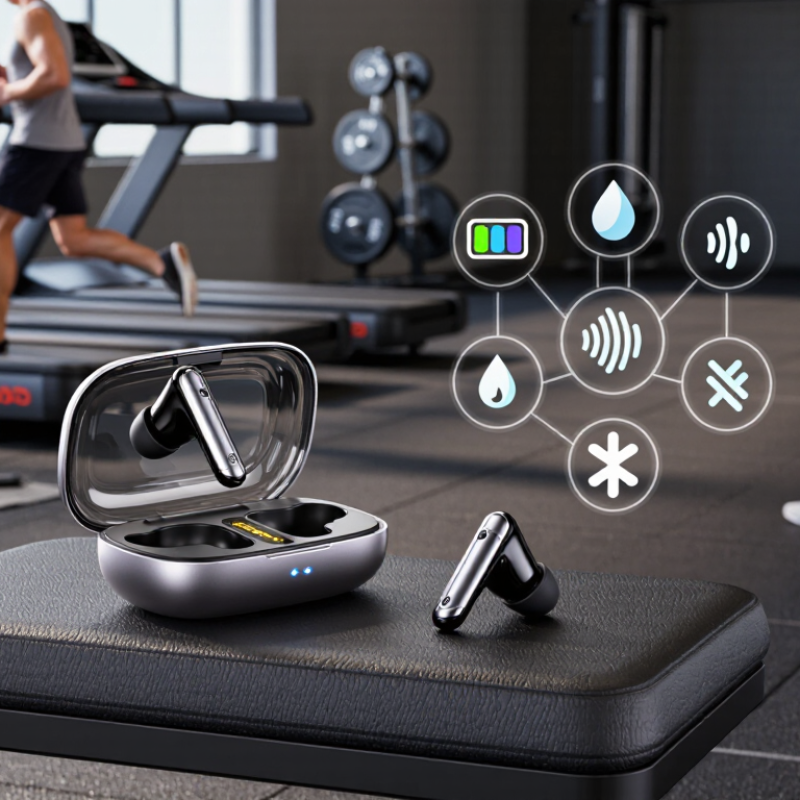
Define Training Priorities: Fit, Safety, Calls, and Battery Runtime
Fit should be tested during movement, not beside a quiet desk. Walk, jog, and turn your head sharply. The earbuds should stay secure without creating pressure near the tragus. My own mistake was choosing a tight seal; after thirty minutes, my ears felt hot and irritated. Sweat resistance also matters. Check the stated protection rating, but remember that water resistance can weaken with age.
Safety deserves equal weight. The World Health Organization’s World Report on Hearing estimates that over 1.5 billion people live with hearing loss. The WHO and ITU safe-listening standard recommends limiting exposure to 80 decibels for up to 40 hours weekly. A transparency mode helps near roads, gyms, and shared paths. It is not perfect. Wind can make outside sound difficult to judge, so keep volume moderate and pause when awareness drops.
Calls need clear microphones, especially outdoors. Look for wind-noise reduction and test speech beside traffic before buying. Battery claims often exclude call time, high volume, and active noise control. Independent testing is more useful than the box number. Consumer Reports and other laboratory reviews commonly measure real playback below advertised figures. For frequent training, choose enough case capacity for several sessions, but avoid carrying a bulky case. A practical target is six to eight hours per charge, with quick charging for rushed mornings. I still prefer comfort over an extra hour.
How to Choose Bluetooth Exercise Earbuds in 2026? - Define Training Priorities: Fit, Safety, Calls, and Battery Runtime
A practical comparison framework for selecting exercise earbuds by training need
| Training Priority |
Recommended Target |
Useful Evidence or Specification |
Why It Matters During Exercise |
Priority Weight |
| Secure fit |
Multiple ear-tip sizes, optional stabilizing fins or ear hooks, and a low-profile shape |
The earbuds remain stable during head movement without creating painful pressure after 30–60 minutes |
A stable seal improves comfort and can help maintain consistent sound during running, cycling, and strength training |
30% |
| Environmental awareness |
An awareness mode that allows external sounds to pass through, or an open-ear design for suitable outdoor routes |
Awareness mode can be activated quickly; volume can be reduced without removing the earbuds |
Helps users hear traffic, cyclists, instructions, and nearby people; awareness features do not replace legal road-safety requirements |
20% |
| Sweat and water resistance |
At least IPX4 for general workouts; IPX5 or higher for frequent outdoor training or heavy sweat |
IPX4 protects against water splashes; IPX5 protects against water jets. Neither rating means the earbuds are suitable for swimming |
Reduces the risk of damage from sweat and light rain when the product is used within its stated rating |
15% |
| Call quality |
Two or more microphones per earbud, wind-noise reduction, and a transparency setting for conversations |
Test calls in a quiet room and outdoors; check whether speech remains clear when wind or gym noise is present |
Microphone processing and wind control are more important than microphone count alone for reliable exercise calls |
15% |
| Battery runtime |
At least 6 hours per charge for regular sessions; 8–10 hours for long training days |
Compare earbud runtime with active noise cancellation enabled, because ANC generally reduces playback time |
A larger practical margin reduces interruptions during long workouts, travel, or consecutive training sessions |
10% |
| Charging convenience |
A charging case that provides at least two additional full charges and supports USB-C charging |
Look for a clearly displayed case battery level and a quick-charge function with stated results |
A case with spare charges is useful when access to a power outlet is limited |
5% |
| Wireless reliability |
Bluetooth 5.2 or newer, stable multipoint only if switching between devices is needed |
Bluetooth version alone does not guarantee range or sound quality; real-world stability depends on the phone, surroundings, and software |
A stable connection prevents dropouts during movement and makes it easier to use the earbuds with training apps |
5% |
Quick selection rule:
Choose fit and environmental awareness first for outdoor exercise, prioritize sweat resistance and stability for high-intensity workouts, and select longer runtime and stronger call performance for full-day training schedules.
Note: IP ratings describe protection against dust or water under controlled test conditions. Check the product instructions, avoid charging wet earbuds, and do not use splash-resistant earbuds for swimming unless the manufacturer explicitly states that they are designed for it.
Verify Bluetooth 5.3, LE Audio, and LC3 Compatibility Before Buying
How to Choose Bluetooth Exercise Earbuds in 2026?
Bluetooth 5.3 should be your starting point, not your final decision. The number alone does not confirm LE Audio or LC3 support. Check the product’s technical sheet and your phone’s operating-system specifications. Both sides must support the same features. Bluetooth SIG’s 2024 Market Update forecasts annual Bluetooth device shipments will grow from 5.4 billion in 2023 to 7 billion by 2028. Compatibility is becoming more important, not less.
LE Audio can reduce power use and support better multi-device behavior. LC3 may maintain clear speech and music at lower bitrates than older codecs. However, real performance depends on firmware, antenna design, and crowded gym signals. I once trusted a “5.3” label and found no LC3 option in the companion settings. That mistake was mine. I had not checked the phone.
Tips: Confirm Bluetooth 5.3, LE Audio, and LC3 on both devices. Ask support for the exact firmware version. Test switching between a phone and a watch. Watch for audio gaps near treadmills and metal equipment. Also check fit, sweat resistance, button control, and microphone quality. A codec cannot fix earbuds that loosen during intervals.
Industry testing also shows why specifications need context. The Bluetooth SIG states that LE Audio introduces more efficient audio transmission and supports broadcast audio. These benefits may appear only after compatible updates. Keep the receipt. Compatibility claims can be incomplete.
Use IEC 60529 IP Ratings to Assess Sweat and Water Protection
How to Choose Bluetooth Exercise Earbuds in 2026?
When workouts become sweaty, IEC 60529 IP ratings provide a useful starting point. The second IP digit measures water protection under controlled laboratory conditions. For example, IPX4 means protection from splashing water, while IPX5 indicates resistance to water jets. IPX7 covers temporary immersion, usually up to one metre for 30 minutes. IPX8 may allow deeper or longer immersion, but the manufacturer must define those conditions. The first digit concerns solid particles, such as dust, not water.
Sweat is more complicated. It contains salt, oils, and minerals that can affect metal contacts, microphones, and acoustic vents. An IPX4 rating may suit light gym sessions, but heavy runners may prefer stronger water protection. Still, a higher rating does not guarantee better sweat durability. IEC 60529 tests fresh water, not months of salty perspiration. That distinction matters.
Check the complete IP code, not a vague phrase like “water resistant.” After training, wipe the earbuds and charging case with a soft, dry cloth. Do not place wet earbuds in the case. That mistake is easy to make. Avoid charging until every contact is dry, and follow the care instructions supplied with the product. I once assumed an IPX7 rating made an earbud safe for every wet situation; that was too broad. Ratings describe specific tests, not unlimited protection. Reflect on your routine, including rain, poolside moisture, and long, sweaty sessions, before choosing.
Apply WHO’s 80 dB/40-Hour Weekly Safe-Listening Benchmark
When choosing Bluetooth exercise earbuds in 2026, treat volume control as a safety feature. The WHO-ITU Global Standard for Safe Listening Devices recommends 80 dB for up to 40 hours weekly. This is a weekly limit, not a daily target. The WHO World Report on Hearing estimates that over one billion young people risk hearing damage from unsafe recreational listening. That warning includes gyms, running routes, and crowded trains.
Choose earbuds with a reliable volume limiter, clear exposure alerts, and stable fit. A secure seal can reduce the temptation to increase volume outdoors. Noise reduction may help, but it cannot make unlimited listening safe. Check whether the earbuds display estimated sound exposure, rather than showing volume alone. Data can be imperfect. Your phone and earbuds may measure sound differently.
Tips: Start near 60% volume and test it in a quiet room. If nearby conversation becomes difficult, lower the volume. Take regular silent breaks during long workouts. Wipe the earbuds after sweaty sessions, and replace damaged tips. I still forget to check weekly exposure after busy training days. That habit needs improvement. Also, the 80 dB benchmark does not guarantee identical safety for every listener. Tinnitus, ear disease, or unusual sensitivity deserves professional hearing advice. WHO guidance should inform your choice, not replace an audiologist’s assessment.
Compare Battery Life, Controls, and Independent Test Results by Price
Choosing Bluetooth exercise earbuds in 2026 requires more than trusting a large battery number.
Bluetooth SIG’s 2024 Market Update reported over five billion Bluetooth devices shipped in 2023. That scale makes careful testing more important. For daily training, compare measured playback time, not only the advertised figure. Independent tables from RTINGS and SoundGuys often show real playback falling about 10–30% below claims, especially with noise cancellation enabled. The difference becomes obvious during a long outdoor run.
Price also changes the trade-offs. Under $60, seek at least six measured hours, physical controls, and stable fit during sweat-heavy movement. Between $60 and $150, seven to nine measured hours is a fair target. Look for separate volume buttons and a case that adds two full charges. Above $150, stronger microphones and better transparency modes may help, but premium pricing does not guarantee longer endurance. A 2024 Consumer Reports headphone-testing guide also stresses repeatable listening tests, rather than manufacturer specifications alone.
Controls deserve a real-world check.
Tap commands can misfire when fingers are wet, while firm buttons may disturb the seal. I once paused music repeatedly while adjusting an earbud mid-run. Annoying, but revealing. Test controls with gloves, sweat, and a phone inside a pocket. Independent reviewers should report codec, volume, ANC settings, and test temperature. Without those details, a battery result is difficult to reproduce. That is where many comparisons remain imperfect.
Conclusion
Choosing Bluetooth Exercise Earbuds in 2026 starts with identifying your training priorities. Consider how securely they fit during movement, whether they support awareness of your surroundings, how clearly they handle calls, and how long the battery lasts. Before purchasing, check for Bluetooth 5.3, LE Audio, and LC3 compatibility to improve connection efficiency, sound quality, and future usability. These features should match your phone and other devices rather than being selected only for their technical appeal.
Sweat and water protection should be evaluated through the IEC 60529 IP rating, with a higher rating generally offering stronger resistance to moisture and dust. For safer listening, use the WHO benchmark of no more than 80 dB for up to 40 hours per week, adjusting volume and listening time when necessary. Finally, compare battery claims, physical or touch controls, comfort, and independent test results across different price levels. The best choice balances reliable performance, safe listening, practical durability, and personal workout needs.