
Choosing the best Wireless Fitness Earphones from China means looking beyond loud bass and attractive packaging. The category spans budget models, established audio brands, and specialist sports designs. A useful starting point is market context. Grand View Research estimated the global wireless earbuds market at USD 10.52 billion in 2023, forecasting a 14.9% compound annual growth rate from 2024 to 2030. That figure covers wireless earbuds broadly, not fitness models alone. Still, it signals a crowded market where specifications need careful checking.
For a fitness-focused guide, we will compare secure fit, sweat resistance, battery life, call clarity, and real-world controls. Counterpoint Research analyst Liz Lee’s commentary on the true wireless stereo market offers a useful expert lens: consumer demand and product differentiation help shape competition. This is a paraphrase, not a direct quotation. It also explains why a familiar brand name cannot replace hands-on testing. Fit first. Small details matter.
A practical test is simple: imagine a damp run, traffic noise, and a phone tucked inside a pocket. Do the earbuds stay seated? Can you adjust volume without breaking stride? Does the published water-resistance rating match the intended use? These questions make comparisons more useful than a feature checklist alone. Yet no single model suits every ear, and product claims can be hard to verify without independent testing. This guide will weigh available evidence, flag trade-offs, and identify what buyers should confirm before choosing Chinese Wireless Fitness Earphones.
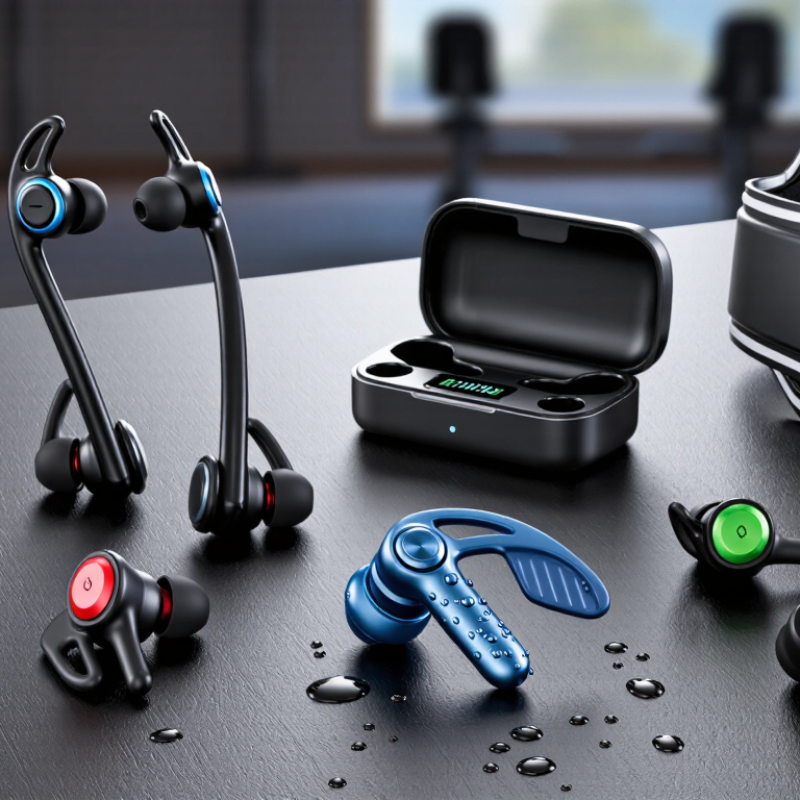
Wireless fitness earphones are small audio devices that receive sound from a phone or watch without a cable. Bluetooth carries digital audio over short-range radio; tiny drivers then turn the signal into sound. A battery powers the radio, amplifier, and controls. Many models also include microphones for calls, while heart-rate sensors are optional, not standard. Fit matters.
During exercise, a secure seal helps keep sound steady as you move. Sweat resistance can help protect the electronics, but it does not mean earphones are waterproof. Check the stated protection rating and clean the contact points after sweaty sessions.
Bluetooth SIG’s 2024 Market Update forecasts about 1.8 billion annual shipments of Bluetooth audio-streaming devices by 2028, reflecting the technology’s broad use. That figure covers many device types, not fitness earphones alone. Not a direct measure of performance.
For a practical choice, test how the earpieces feel during a jog and whether controls are easy to use with damp fingers. Battery life depends on volume, call use, and features such as noise cancellation. Codec support can affect sound, but a stable connection and comfortable fit may matter more during training.
One detail is easy to overlook: advertised battery figures often describe ideal conditions. Your actual session may be shorter. Bluetooth SIG, 2024 Market Update.
When comparing wireless fitness earphones from China, judge them during movement, not just on a spec sheet. Fit is not cosmetic. A secure wing or shaped tip should stay put through a head turn, treadmill bounce, and sweaty cooldown. ACSM’s 2025 Worldwide Survey of Fitness Trends ranked wearable technology first, reflecting the growing role of tech in training. Still, a popular category does not prove every design fits every ear.
For sweat protection, look for a stated IP rating, not vague “sport” language. Under IEC 60529, IPX4 indicates protection from water splashes; it does not guarantee protection from salt buildup or careless rinsing. Wipe charging contacts after sessions. Small habit, real payoff. WHO’s 2024 update estimated that 1.8 billion adults were insufficiently active in 2022. That was 31% of adults worldwide.
Sound should keep vocals clear at a safe listening level, with enough bass for rhythm but no muddy kick drum. Treat advertised battery life as a best-case estimate: volume, calls, and noise cancellation can shorten it. Look for a case that supports several sessions between charges, plus physical controls that work with damp fingers. One weak point deserves attention: a fit that feels secure indoors may rub during a longer run. Give the earphones a real workout before trusting them.
Chinese audio makers offer several fitness-focused designs, each suited to a different training routine. Compact true wireless models often include flexible ear fins that help steady the fit during runs. Open-ear hook styles leave the ear canal uncovered, which can feel more comfortable during long outdoor sessions. Neckband models remain practical for people who dislike handling small earbuds between sets. Fit matters.
Look for physical controls that are easy to press with damp fingers. A secure charging case and clearly marked left and right earpieces also make daily use simpler. For gym training, check the stated water-resistance rating and read what it covers; sweat protection does not automatically mean safe for swimming. Microphone performance can vary in a noisy gym, even when music sounds clear.
Before choosing a model, try gentle head movements and a short jog, if a return period allows. Ear shape changes how well fins and hooks stay in place, so reviews cannot settle every fit question. Battery estimates are useful, but volume and call use affect real results. I would not choose by bass alone. A booming sound may mask footfalls or coaching cues, and that trade-off is easy to overlook.
IPX4 protects against splashing water, IPX5 against water jets, and IPX7 against temporary immersion in up to 1 meter of water for 30 minutes under test conditions. The rating numbers are ordinal—not a measure of workout suitability or a guarantee against damage. “X” means no dust-protection rating is specified.
Chinese-made wireless fitness earphones span a wide price range. Entry-level models often cost about $15–30, while mid-range options commonly sit around $35–70. These are rough online price bands; discounts, shipping, and local taxes can change the final cost. A low price may still buy secure ear hooks and basic sweat resistance, but call quality and app controls can be less consistent.
At the mid-range, buyers may find stronger battery life, clearer microphones, and more stable Bluetooth connections. During a run, a snug fit matters more than an impressive feature list. Check the stated water-resistance rating, but remember that sweat protection does not guarantee protection from every kind of moisture. Useful details. Still, published battery figures usually reflect ideal testing, not a windy commute with high volume.
Above $80, some models add better noise handling or more refined sound, yet the improvement is not automatic. Compare independent measurements and return policies, rather than trusting price or specifications alone. One awkward detail: touch controls can misread taps when fingers are damp. For value, a well-fitting mid-priced pair may outperform a cheaper set with a longer advertised battery life, though comfort varies from ear to ear.
For running or circuit training, prioritize a secure fit, simple controls, and resistance to sweat. A loose earphone becomes distracting when you turn your head or jump. Fit matters most. For gym sessions, physical buttons can be easier to use than touch controls with damp fingers. A useful caveat: no design stays comfortable for every ear, so test the fit before committing. Check the stated water-resistance rating, too. Sweat resistance does not automatically mean safe for swimming; verify that the model is rated for immersion.
Your device matters as much as your workout. Confirm compatibility with your phone’s operating system, and check whether you can pair with a smartwatch or laptop if needed. Bluetooth pairing should be straightforward, but multipoint support is not universal. The ACSM’s 2024 Worldwide Survey of Fitness Trends ranked wearable technology as the year’s leading fitness trend, underscoring how often people use connected devices during exercise. Still, extra app features are only useful when they work reliably with your setup. For outdoor runs, consider an open-ear design that lets you hear nearby traffic; for noisy gyms, a secure in-ear fit may help you focus. Check it before buying.
| Workout or Use | Suitable Earphone Style | Fit and Comfort | Protection to Look For | Device and Connection Checks | Practical Buying Tip |
|---|---|---|---|---|---|
| Running outdoors | Open-ear or secure in-ear wireless earphones | Choose a stable fit that does not loosen with repeated movement. An open-ear design leaves the ear canal uncovered. | IPX4 or higher can help protect against splashes and sweat; ratings do not guarantee protection from every exposure. | Check that the phone supports the earphones’ Bluetooth version and that controls work with the phone’s operating system. | For road running, consider how well you can hear surrounding traffic. Open-ear designs do not replace attentive listening. |
| Gym training and weightlifting | True wireless in-ear earphones with a secure fit | Try the supplied ear-tip sizes; a good seal can improve stability and passive noise isolation. | IPX4 is a common baseline for splash and sweat resistance. Check the product documentation for cleaning and care guidance. | Confirm Bluetooth pairing with your phone, tablet, or laptop. Multipoint connection is useful only if both the product and your devices support it. | Prioritize comfort during longer sessions, easy-to-use controls, and a case that fits your gym bag. |
| HIIT and circuit workouts | In-ear earphones with ear hooks, wings, or another stabilizing feature | Look for a design that stays secure during jumping and quick changes of direction. | Choose a clearly stated sweat or water-resistance rating; IPX4 indicates protection against water splashes, not submersion. | Test call and audio controls with your phone before training, especially if you rely on voice assistants. | Fit is especially important: loose earphones may fall out even when their water-resistance rating is suitable. |
| Cycling | Open-ear style for awareness, or secure in-ear style where appropriate | A secure fit matters on bumpy routes; avoid adjustments while riding. | Consider sweat and rain exposure, and check the stated rating and manufacturer’s care instructions. | Check Bluetooth range and call performance with your phone in its usual carrying position. | Follow local rules on headphone use while cycling. Audio can reduce awareness even with open-ear designs. |
| Swimming | Swim-specific earphones designed for water use | Choose a model made for swimming, with a fit intended to remain secure in water. | Look for explicit swimming suitability and the manufacturer’s stated depth and duration limits; a splash-resistance rating alone is not enough. | Bluetooth signals do not travel reliably through water. For underwater listening, check for built-in storage and supported audio-file formats. | Do not assume ordinary Bluetooth earphones can stream audio underwater, even if they have a high water-resistance rating. |
| Walking, commuting, or light exercise | Open-ear or conventional in-ear wireless earphones | Choose the style that stays comfortable for the length of your usual session. | At least basic sweat and splash resistance may be useful for exercise; verify the exact rating rather than relying on general wording. | For laptops and phones, check Bluetooth compatibility, microphone behavior, and whether the device can switch between calls and media as expected. | Noise cancellation can reduce awareness of nearby sounds; use it thoughtfully in public spaces. |
Before buying, check the product’s published fit, water-resistance, battery, charging, and compatibility details. Bluetooth codec support depends on both the earphones and the connected device; a codec listed for one side alone does not guarantee its use.
True wireless earbuds with flexible fins can stay secure during runs. Try a short jog if returns are allowed. Fit matters most.
Open-ear hooks leave the ear canal uncovered and can help you hear nearby traffic. Comfort still depends on your ears.
Not necessarily. Check the stated water-resistance rating and whether it covers immersion. Sweat protection alone is not enough.
Entry-level models often cost about $15–30, while mid-range options commonly cost $35–70. Shipping and local taxes can change the final price.
No. Models above $80 may offer improved sound or noise handling, but the difference is not guaranteed. Compare measurements and return policies.
Choose a secure fit and controls that work with damp fingers. Physical buttons may be easier than touch controls. A loose earbud gets distracting fast.
Treat them as useful guides, not promises. High volume and frequent calls can reduce actual battery life. Windy commutes may add another wrinkle.
Confirm phone compatibility and check smartwatch or laptop support if needed. Multipoint pairing is not universal, and app features can be unreliable.
Not by itself. Heavy bass may mask footfalls or coaching cues. I might still overlook that trade-off.
Wireless Fitness Earphones are designed to keep music, podcasts, or workout instructions accessible while you move. They connect wirelessly to compatible devices and send audio without a cable running between the earphones and your phone or player. For training, a secure and comfortable fit helps them stay in place, while sweat resistance can make them more suitable for active use. Clear sound, simple controls, and battery life that matches your typical workout are also important considerations.
Chinese-made fitness earphones span a range of prices and features, so comparing comfort, durability, audio quality, and battery performance can help you find a suitable option. The best choice depends on how you exercise: running may call for a stable fit, while gym sessions may benefit from easy-to-reach controls and reliable device connectivity. Check that the earphones work with your phone or other audio device, and consider which features matter most before choosing.